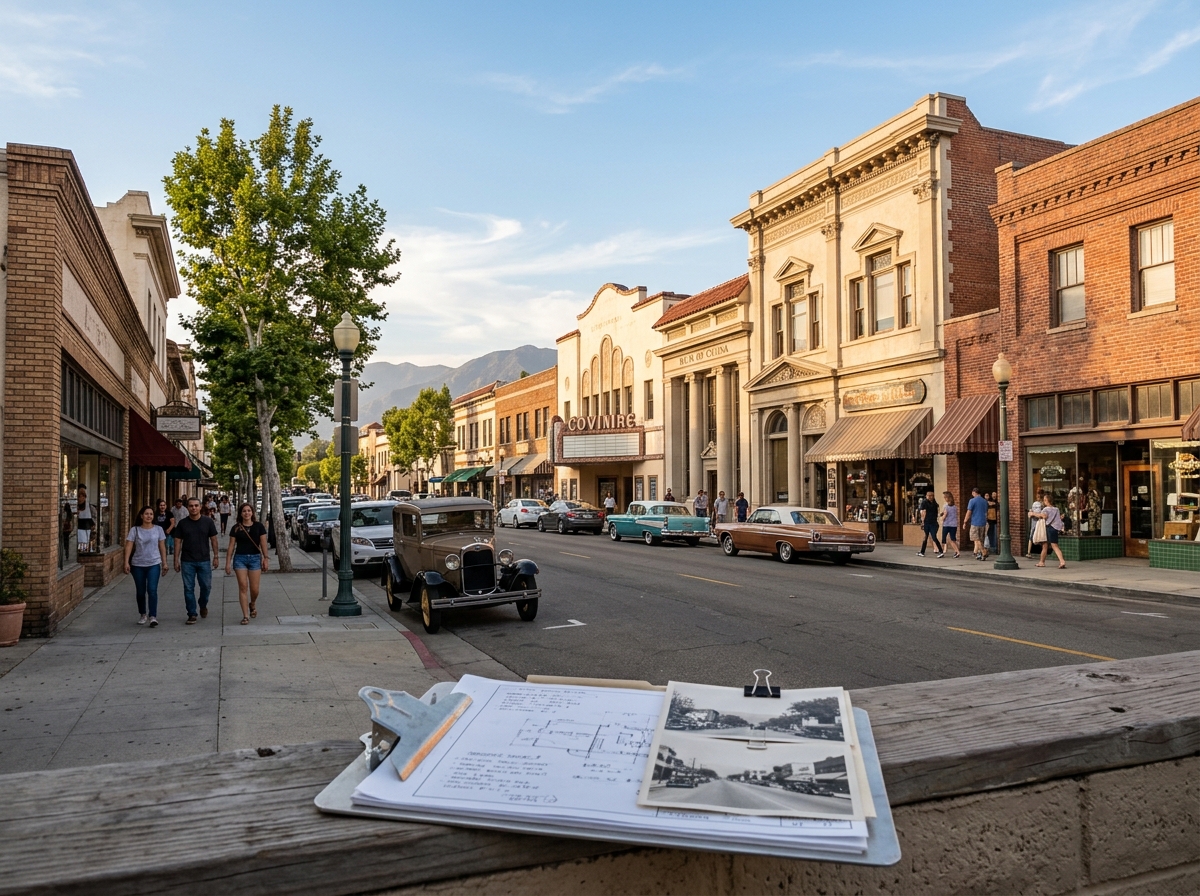
Some of Covina’s most valuable historical records are not old photographs or handwritten letters. They are surveys that document buildings, streets, architectural details, and neighborhoods before those places change.
One of the most important examples is the Covina Town Center Historic Resource Survey. The City of Covina Planning Division identifies the study as a historic resource survey prepared by Historic Resource Partners in spring 2007 for the City.
The survey provides a useful window into how preservation professionals examine a historic downtown. Instead of asking only whether a building is old, surveys consider architecture, historical associations, physical condition, alterations, and the larger development patterns that shaped an area.
For anyone interested in Covina history, that approach changes the way familiar buildings can be viewed. An ordinary storefront may represent an earlier period of commerce. A modest building may preserve architectural details that have disappeared elsewhere. A group of structures may tell a stronger story together than any one property could tell alone.
What a Historic Resource Survey Actually Does
A historic resource survey is essentially an organized effort to identify, record, and evaluate places that may have historical importance.
The California Office of Historic Preservation explains that surveys help communities understand their historic resources, make planning decisions, establish preservation priorities, conduct environmental review, and increase public appreciation of the built environment.
Survey work can involve examining a building’s construction period, architecture, setting, known history, previous alterations, and relationship to broader historical themes. Researchers may combine field observations with building records, maps, photographs, directories, newspapers, and other archival materials.
That means the survey process connects physical places with documentary history. The building provides evidence, but archives help explain why that evidence matters.
The 2007 Survey Focused on Covina’s Town Center
One important limitation should be understood before using the 2007 Covina survey. It was a Town Center survey rather than a complete inventory of every potentially historic property throughout the entire city.
This focus makes sense because Downtown Covina contains one of the city’s strongest concentrations of older commercial and civic development. The City describes the Citrus Avenue District as Covina’s historic central core and notes that several buildings there date to the early 1900s.
Later City cultural-resource studies have continued to cite the 2007 survey when researching Covina properties, while also noting when project sites fall outside the survey’s geographic boundaries. That distinction is important.
A property missing from the Town Center survey should not automatically be interpreted as historically insignificant. It may simply have been outside the area being studied.
Why Survey Boundaries Matter
Covina’s history extends well beyond Citrus Avenue. Agricultural properties, residences, schools, industrial buildings, transportation sites, commercial corridors, and postwar neighborhoods can all contribute to the city’s historical story.
A focused survey can document one especially important area in detail, but it does not necessarily answer every preservation question for the rest of the community.
This is one reason historic surveys are best understood as evolving research tools rather than permanent final lists.
Age Alone Does Not Make a Building Historic
One of the biggest lessons from historic-resource research is that “old” and “historic” are not identical terms.
A building may survive for many decades without possessing the historical associations, architecture, or integrity necessary to qualify as a significant historic resource. Conversely, a relatively modest structure can be important because it represents a distinctive type of architecture, an important event, a pattern of local development, or a person significant to the community.
Physical integrity matters as well. Researchers consider whether enough original features remain for a building to communicate its historical significance. Windows, storefronts, rooflines, materials, entrances, additions, and other changes can influence that evaluation.
This does not mean every alteration destroys historical value. Buildings naturally evolve. The question is whether the characteristics that make a property historically meaningful remain understandable.
Downtown Buildings Tell a Larger Story Together
Individual buildings matter, but downtown history is also about relationships between buildings.
Citrus Avenue developed as Covina grew from an agricultural settlement into a commercial center. Its traditional streetscape reflects an era when businesses were positioned close to sidewalks and residents could move between shops, civic destinations, and services within compact blocks.
Looking at one storefront in isolation may reveal architectural details. Looking at an entire block can reveal a historical pattern.
This is why preservation discussions often consider streetscapes, districts, building groupings, and surrounding context. A collection of older structures can communicate the scale and development pattern of an earlier downtown even when individual tenants and interiors have changed many times.
Today, that historic pattern remains relevant as Covina works to combine downtown investment with walkability and preservation. Older buildings continue to house modern restaurants, shops, entertainment, and other uses while contributing to the recognizable character of Citrus Avenue.
Archives Help Explain What Buildings Cannot
A building can show its materials and architecture, but it cannot explain every person or event associated with it. That is where archives become essential.
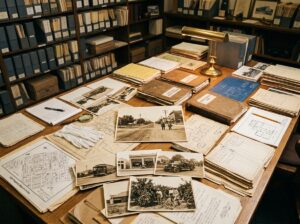
The Covina Valley Historical Society preserves thousands of documents and photographs along with scrapbooks, early invoices, legal documents, citrus records, artifacts, and other materials related to local history.
These records can help researchers identify previous businesses, property uses, residents, architectural changes, and connections to Covina’s agricultural or commercial development.
Historical photographs are particularly useful. A modern facade may hide earlier architectural details, while an archival image can show what a building looked like decades before alterations occurred.
Maps, directories, permits, newspapers, and property records can add another layer by helping researchers establish dates and uses. Together, physical buildings and archival evidence create a more complete historical record.
Why a 2007 Survey Still Matters in 2026
The Covina survey is now a historical document in its own right. Buildings and streetscapes may have changed considerably since researchers documented the Town Center in 2007.
That does not make the survey obsolete. In fact, comparing an older survey with today’s streetscape can show which buildings have survived, which have been altered, and which places may have disappeared.
At the same time, preservation standards recognize the importance of keeping surveys current. California’s Office of Historic Preservation advises communities to update older surveys so they can account for newly significant properties, previously overlooked resources, physical alterations, relocation, and demolition.
That is especially relevant because historical significance changes with time. Buildings that were too recent to receive much attention in 2007 are nearly two decades older today. Mid-century and postwar properties may now deserve greater consideration within the story of Covina’s suburban development.
Historic Surveys Can Influence Modern Planning
Historic surveys are not created only for historians. They can also help planners understand potential cultural resources when development is proposed.
The Covina Planning Division states that it administers the City’s historic preservation ordinance and plan while reviewing development, remodeling, and alterations to buildings. Historic information can therefore become relevant when older properties face substantial changes.
At the state level, historic resources can also matter during environmental review under the California Environmental Quality Act. A survey itself is not the same thing as formally designating every property as a landmark, but properly prepared historic-resource information can help agencies determine whether additional evaluation is necessary.
For residents who want to research how local decisions were made, the City’s Public Records resources offer another route for finding municipal documents that may provide historical context.
What Buildings Are Worth Remembering?
The answer is more complicated than identifying the oldest structure on a block.
A building may be worth remembering because of its architecture. Another may represent Covina’s citrus industry. Another could illustrate early commercial development, civic life, transportation, postwar suburbanization, or the work of a notable local builder.
Sometimes the most revealing places are not monumental landmarks at all. They are ordinary storefronts, warehouses, homes, offices, and public buildings that help explain how people actually lived and worked.
The 2007 Covina Town Center Historic Resource Survey reminds us that preservation begins with documentation. Before a community can decide what should be protected, adapted, interpreted, or remembered, it first needs to understand what exists and why it may matter.
As Covina continues to change, older surveys, photographs, planning documents, and surviving buildings become increasingly valuable points of comparison. Together they allow residents to see not only what Downtown Covina looks like today, but how layers of earlier history remain embedded in the streets around them.
Covina History will continue exploring those records and the buildings they help bring back into focus.