
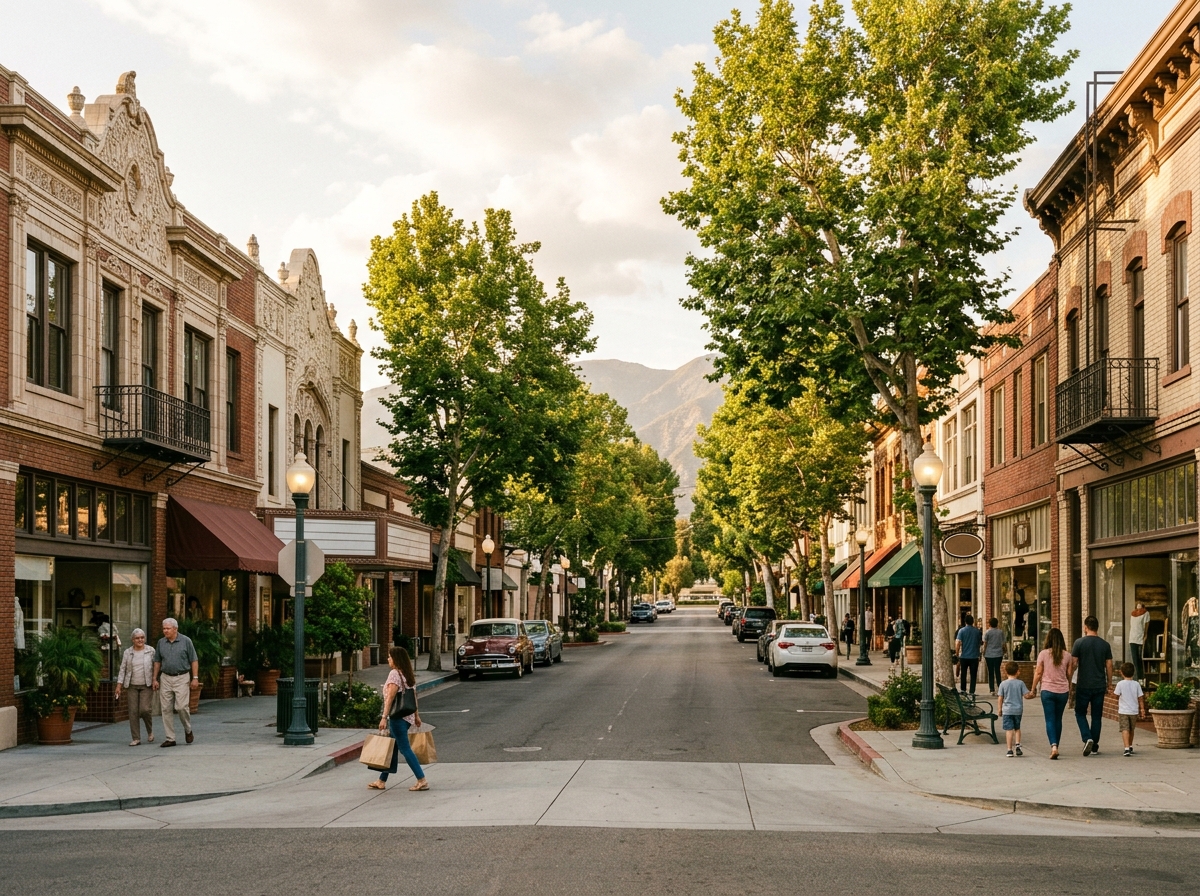
Covina’s history is not limited to photographs, books, or museum collections. Traces of the city’s past remain visible throughout Downtown Covina, local parks, historic buildings, civic spaces, and streets that have served generations of residents.
Founded in the late nineteenth century, Covina grew from an agricultural settlement into a community closely associated with citrus production, railroad transportation, local commerce, and eventually suburban development. Although much of the surrounding agricultural landscape has disappeared, several historic places in Covina still provide opportunities to experience parts of that story firsthand.
Some locations can be explored freely, while museums and historic interiors may have limited schedules or require appointments. Conditions can also change, so visitors should confirm current access before making a special trip.
Walk Through Historic Downtown Covina
One of the best places to begin exploring Covina history is the Citrus Avenue District. The City of Covina identifies Citrus Avenue as the city’s historic downtown and central core, where several buildings date to the early twentieth century.
Walking along Citrus Avenue provides a sense of the traditional scale of the old commercial district. Storefronts sit close to sidewalks, blocks are compact, and older architectural details remain visible among contemporary restaurants, shops, entertainment spaces, and other businesses.
The businesses occupying individual buildings have changed many times, but the overall streetscape still helps explain how downtown developed before automobile-oriented shopping centers became common throughout Southern California.
The district is particularly useful for understanding how preservation and everyday life can coexist. Downtown Covina is not a reconstructed historical attraction. It remains an active commercial district in which older buildings continue to serve modern purposes.
Explore Heritage Plaza and Its Historical Walk
At 400 N. Citrus Avenue, Heritage Plaza Park provides another easy stop for anyone exploring downtown history. The City lists a Historical Walk among the park’s amenities, along with a stage, picnic tables, play equipment, and public gathering space.
Heritage Plaza is significant because it sits directly within the historic downtown environment. Rather than separating history from current community activity, the plaza combines the two. Public events, everyday gatherings, and the historical features of the area all occupy the same space.
The Covina Town Center planning framework also treats Heritage Plaza as an important public-space anchor for the Citrus Avenue District. The City’s long-term vision emphasizes a walkable downtown where visitors can move between businesses, public spaces, and transportation connections on foot.
For visitors who want a simple introduction to historic Covina without scheduling a museum visit, combining Heritage Plaza with a walk along Citrus Avenue is one of the easiest options.
See Covina’s Historic Firehouse and Jail
Just behind Covina City Hall at 125 E. College Street stands one of the city’s most important historic civic buildings. The Firehouse/Jail was erected in 1911 and served as Covina’s first civic building.
The structure eventually became the Firehouse/Jail Museum operated by the Covina Valley Historical Society. Its collection includes artifacts connected with early rural life, historic photographs, scrapbooks, invoices, legal records, and materials related to Covina’s citrus industry.
There is an important current access note for visitors. The Historical Society presently lists the Firehouse/Jail Museum as temporarily closed for reconstruction. Visitors should therefore not assume that the museum interior is available simply because older sources list regular Sunday hours.
The building and surrounding historic downtown setting are still worth recognizing as part of a walking tour, but anyone hoping to enter the museum should check directly with the Historical Society for the latest reopening information.
Why the Building Matters
The Firehouse/Jail reflects an era when Covina was still a relatively small community. Its former uses as a firehouse, civic facility, and municipal jail provide a direct link with the development of local government and public services.
The archives preserved there are equally significant. Historic records often reveal details that buildings alone cannot, including information about residents, businesses, agriculture, and everyday community life.
Visit Heritage House by Appointment
Another property maintained by the Covina Valley Historical Society is Heritage House, located on the west side of Covina Park at 300 N. Valencia Avenue.
The Craftsman-style residence was originally built for William Nash, a local pharmacist. When the house faced demolition, the Historical Society preserved it by relocating it to Covina Park in 1989.
Today, the house functions as a furnished historical museum that offers a glimpse of domestic life around the turn of the twentieth century. Rather than presenting only isolated artifacts, the house allows visitors to experience objects within a residential setting.
Current information from the Historical Society lists Heritage House as open by appointment only. Visitors should make arrangements before traveling specifically to see the interior.
The preservation of Heritage House demonstrates another side of local history. Historic places do not always survive in their original locations. Sometimes saving a structure requires moving it and finding a new purpose for it.
See Historic Photographs at Covina City Hall
Historic photographs can reveal changes that are difficult to recognize when looking only at the modern city. Covina City Hall is home to the “Vintage Years” photographic exhibit, which the City describes as a collection of approximately 130 historical photographs depicting Covina from 1846 through 1950.
The exhibit offers views of an earlier Covina when citrus groves, agricultural businesses, older streetscapes, and a much smaller population defined the community.
The City’s official history page states that the exhibit is available for self-guided viewing during regular City Hall business hours. Because municipal hours can change, visitors should confirm the current schedule before visiting.
This stop pairs naturally with the nearby Firehouse/Jail building and Citrus Avenue. Together, the photographs and surviving streetscape make it easier to compare historical Covina with the city that exists today.
Look for History Inside Covina Park
Covina Park is more than a recreation area. The City’s current park listing identifies historical murals at the bandshell among the park’s features.
The park also provides the setting for Heritage House, creating an opportunity to combine public art, recreation, and architectural history during the same visit.
Murals are useful forms of public history because they bring historical themes into places residents use regularly. Unlike archives that require deliberate research, public artwork can introduce local stories during a walk through a park or downtown street.
The same idea is increasingly visible elsewhere in Covina, where new public art projects have incorporated references to local history and community identity.
Take a Guided Downtown History Walk
Visitors who want more context than a self-guided walk can also watch for downtown walking tours offered by the Covina Valley Historical Society. Its current website describes free walking tours through historic Downtown Covina during selected months, generally traveling along Citrus Avenue and nearby alleys while discussing pioneer and commercial history.
Tour schedules can change, so checking the Historical Society’s current information is important before planning a visit.
A guided tour can reveal details that are easy to overlook, such as changes in building use, architectural features, former businesses, and connections between downtown development and the citrus economy.
Historic Covina Is Still Part of Everyday Life
The most interesting thing about historic places in Covina is that many remain part of an active community. Citrus Avenue still functions as a commercial street. Heritage Plaza hosts gatherings. Covina Park continues serving residents. City Hall remains a working civic building, while preserved structures and collections provide links to earlier generations.
That mix makes exploring Covina history different from visiting a single historical attraction. The city’s past is distributed throughout streets, parks, architecture, photographs, public art, and preserved buildings.
Visitors should remember that access to museums and historic interiors can change. The Firehouse/Jail Museum is currently undergoing reconstruction, and Heritage House requires an appointment. Checking official sources before visiting will prevent relying on outdated schedules.
For more stories about the buildings, neighborhoods, transportation routes, and people that shaped the community, return to Covina History as we continue documenting the city’s past and the places where that history can still be seen.