
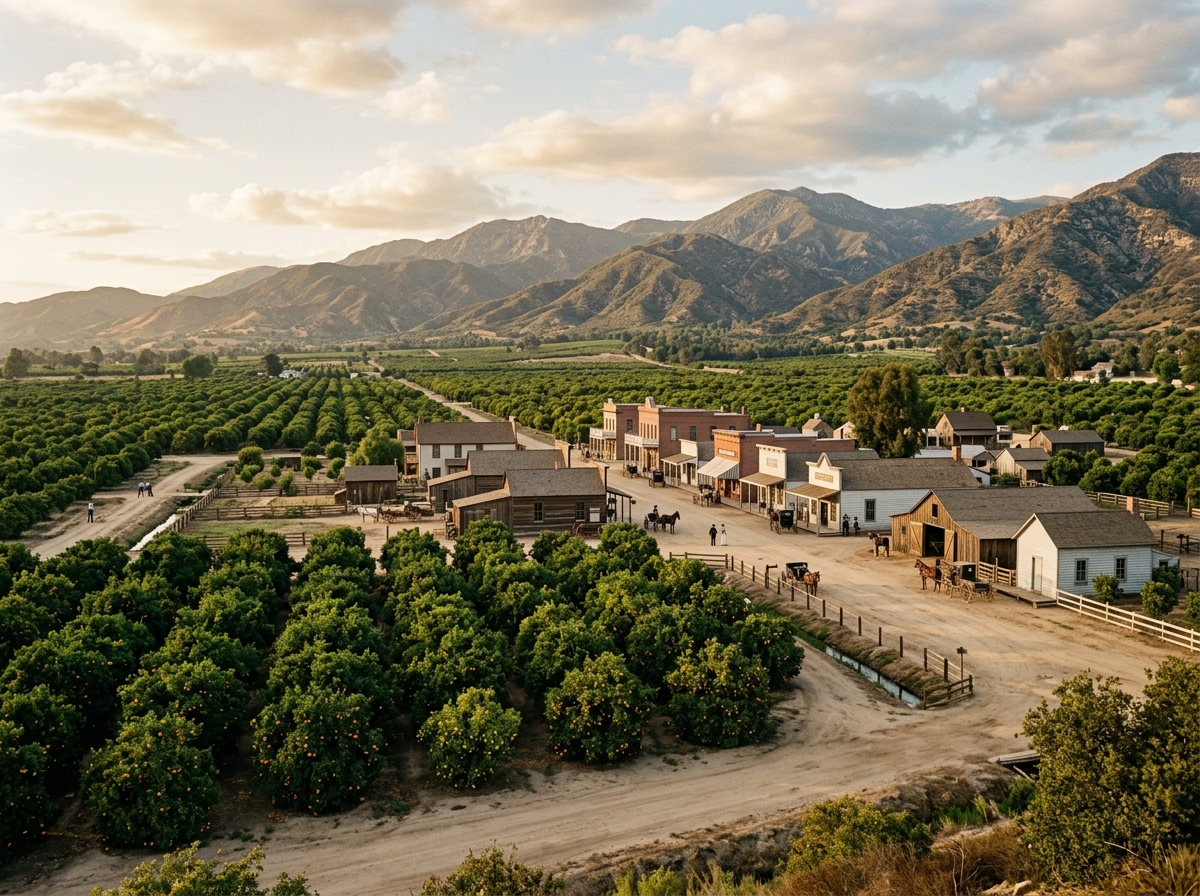
Modern Covina is a compact San Gabriel Valley city surrounded by freeways, established neighborhoods, commercial corridors, schools, parks, and regional transportation. Its beginnings looked very different. The community that eventually became Covina emerged from an agricultural landscape where land, water, crops, and access to transportation determined whether a settlement could prosper.
The City of Covina’s current history page dates the city’s founding to 1882. Other City cultural-resource studies provide additional detail, tracing the development of the townsite through land acquired by Joseph Swift Phillips beginning in 1881 and noting that some historical research recognizes 1886 as the founding date. What is certain is that the community developed during the 1880s and incorporated as the City of Covina in 1901.
From those beginnings came a story shaped by citrus groves, railroads, downtown commerce, suburban expansion, and more than a century of changing land use.
Joseph Swift Phillips and the Early Townsite
The development of Covina is closely associated with Joseph Swift Phillips. According to City cultural-resource research, Phillips moved to the Los Angeles area in 1879. In 1881, he purchased approximately 2,000 acres from John E. Hollenbeck in an area that had once formed part of Rancho La Puente.
Phillips hired surveyor Fred Eaton, who later served as Los Angeles city engineer and mayor, to divide portions of the property. About 120 acres were set aside for a townsite in the area where Downtown Covina eventually developed.
The name Covina itself is also connected with Eaton. Historical accounts credit him with creating the name while surveying Phillips’ property.
These early plans did not immediately produce the suburban city residents know today. Settlers were entering a largely agricultural environment where successful farming depended on finding crops suited to local soil, climate, irrigation, and markets.
Agriculture Came Before the Citrus Boom
Covina is remembered strongly for citrus, but oranges were not the only crops early settlers tried. Farmers experimented with wheat, barley, deciduous fruits, vegetables, and other agricultural products while searching for reliable ways to make the land profitable.
Irrigation was a constant concern. Southern California agriculture could not depend entirely on rainfall, so access to water and improvements in irrigation helped determine what could be grown successfully.
Citrus gradually emerged as one of the area’s most important crops. During the late nineteenth and early twentieth centuries, orange and grapefruit groves became increasingly prominent across Covina and neighboring parts of the San Gabriel Valley.
The change influenced more than the landscape. Citrus farming created demand for labor, packing facilities, transportation, equipment, financial services, stores, and businesses that supported growers and their families.
The Railroad Connected Covina to Larger Markets
A successful agricultural community needed a practical way to move perishable fruit beyond the local area. Transportation became one of the most important forces in Covina’s development.
Southern Pacific rail service reached Covina in 1895. The arrival of the railroad made it easier for growers to ship citrus to larger markets and encouraged packing and processing operations to develop close to the tracks.
City historical research indicates that several packinghouses eventually operated around the railroad corridor. These facilities received fruit from surrounding groves, prepared it for shipment, and connected Covina’s agricultural economy with buyers far beyond the San Gabriel Valley.
The railroad also reinforced the importance of the developing town center. Businesses serving growers, workers, travelers, and residents clustered in and around the commercial district.
Covina Became an Incorporated City in 1901
The agricultural settlement eventually developed enough civic organization to become an incorporated municipality. Covina incorporated in 1901 as a California General Law city.
Incorporation represented an important transition. Covina was no longer simply a collection of farms, homes, and businesses. It had a municipal government responsible for providing and managing local services as the community expanded.
The early twentieth century also produced some of the buildings and streetscapes that residents still associate with historic Covina. Downtown Citrus Avenue developed as a center for shopping, services, civic activity, and community life.
Today, surviving buildings and historical records from this period help illustrate the transformation from agricultural town to established city. The Covina Valley Historical Society preserves photographs, documents, citrus records, artifacts, and other materials that provide additional evidence of these early decades.
Citrus Helped Define Covina’s Identity
By the early twentieth century, citrus was deeply connected with Covina’s economy and public identity. The City’s General Plan describes citrus as the predominant crop by the turn of the century and notes Covina’s importance as an orange-shipping community.
Rows of trees extended across land that would later become residential neighborhoods and commercial districts. Packinghouses near the railroad served the surrounding agricultural landscape, while downtown businesses supported residents whose livelihoods were directly or indirectly connected with farming.
Citrus therefore shaped more than Covina’s economy. It influenced the physical organization of the community, patterns of employment, transportation, and the way Covina presented itself to the wider region.
Postwar Growth Replaced Many of the Groves
The landscape changed dramatically during the decades after World War II. Across Southern California, rapid population growth increased demand for housing, roads, shopping areas, schools, and public facilities.
Covina experienced the same transition. Agricultural land was subdivided for residential development, and streets expanded through places once dominated by orchards.
Automobiles also changed development patterns. Residents were no longer as dependent on downtown or rail transportation for everyday travel. New commercial areas could develop along major roads and closer to expanding residential neighborhoods.
Covina gradually became the mature suburban community described in modern planning documents. The citrus landscape largely disappeared, but its influence remained visible in local history, surviving industrial sites, street patterns, photographs, and the stories preserved by residents and historical organizations.
Downtown Remained a Link to Earlier Covina
Even as suburban development transformed the surrounding city, Downtown Covina continued to provide a physical connection with the earlier community.
Citrus Avenue retained its smaller blocks, pedestrian-oriented storefronts, and collection of older commercial buildings. Instead of abandoning the historic core entirely, later planning efforts increasingly focused on maintaining its distinctive character while adapting downtown to contemporary needs.
This helps explain why Downtown Covina feels different from many newer commercial corridors. Its physical layout reflects a period when people walked between stores and services and when the commercial district served a much smaller city.
New restaurants, shops, entertainment, housing, and public improvements continue to change the area, but the underlying historic streetscape still communicates part of Covina’s earlier development.
From a Small Townsite to a Modern City
The scale of Covina today makes the transformation particularly clear. The U.S. Census Bureau recorded 51,268 residents in the 2020 Census within approximately 7.04 square miles. The Census Bureau’s current QuickFacts profile estimated the population at 49,404 as of July 1, 2025.
Those figures describe a community very different from the agricultural settlement Phillips helped develop during the 1880s.
Yet many stages of Covina’s growth are still connected. Early land subdivision created the townsite. Agriculture attracted settlers and investment. Citrus provided an economic foundation. Rail transportation connected growers with larger markets. Incorporation created a municipal government. Postwar development replaced orchards with neighborhoods, while Downtown Covina remained a reminder of the city’s earlier scale.
Covina’s Origins Are Still Visible Today
Understanding Covina history means looking beyond a single founding date. The city developed gradually through decisions about land, farming, transportation, commerce, housing, and public life.
The current City history page uses 1882 as Covina’s founding date, while historical studies provide additional milestones surrounding Phillips’ 1881 land purchase, development of the townsite, later recognition of an 1886 founding date in some records, and incorporation in 1901. Rather than conflicting stories, those dates illustrate that communities usually emerge through a process rather than a single moment.
More than a century later, traces of those beginnings remain in Downtown Covina, the railroad corridor, preserved photographs, historical buildings, museum collections, and the names and stories connected with the citrus era.
As Covina continues to change, Covina History will continue documenting how the city’s earliest chapters shaped the San Gabriel Valley community residents know today.